

How Much Are U.S. Companies Really Spending on AI in 2026? The Numbers Behind the AI Spending Boom
U.S. companies are spending more on AI in 2026, but the biggest numbers are concentrated in cloud infrastructure, chips, data centers, software, and services rather than simple AI subscriptions. Enterprise budgets are rising, yet many businesses remain focused on measurable productivity and cost savings. The key question is no longer whether companies spend on AI, but where and why.
The AI Spending Boom Is Bigger—and More Complicated Than It LooksArtificial intelligence has moved from an experimental technology budget to a major corporate investment category in the United States. In 2026, companies are spending money on AI models, software subscriptions, cloud computing, custom applications, data infrastructure, cybersecurity, employees, consultants, specialized hardware and, at the largest end of the market, enormous data-center projects.
That makes one seemingly simple question surprisingly difficult to answer: How much are U.S. companies actually spending on AI in 2026?
There is no single accounting line called “AI spending” across corporate America. A company might classify an AI-enabled software subscription as ordinary software expenditure, while another may place GPU purchases under capital expenditure. A retailer could count an AI customer-service platform as an operating expense, while a technology company may spend billions building the infrastructure that ultimately serves thousands of businesses.
The best available data therefore has to be interpreted rather than simply quoted.
Gartner estimates worldwide AI spending will reach approximately $2.59 trillion in 2026, up 47% from 2025. More than 45% of that spending is expected to go toward AI infrastructure, including AI-optimized servers, networking, semiconductors and infrastructure services. Gartner also says enterprise spending has not yet reached its full potential, meaning the headline figure is heavily influenced by technology vendors and hyperscalers.
For U.S. businesses, that distinction is critical. The AI spending boom is real, but much of the money circulating through the AI economy is concentrated among a relatively small number of very large technology companies.
At the same time, ordinary enterprises are moving from experimentation toward broader deployment. McKinsey's 2026 research found that 60% of surveyed organizations expect to increase AI investment over the following year, while 28% say AI represents more than 10% of their total enterprise-wide information and communications technology budget.
The result is a two-speed market: enormous infrastructure spending at the top, and increasingly disciplined operational spending throughout the broader economy.
What Counts as AI Spending in 2026?Before looking at the numbers, it helps to define what companies are actually paying for.
AI spending in 2026 generally falls into several interconnected categories. The first is infrastructure. This includes GPUs and other accelerators, servers, networking equipment, storage, electricity, data-center capacity and cloud infrastructure.
The second is software. Businesses increasingly pay for AI-enabled productivity suites, coding assistants, customer-service platforms, enterprise search, document intelligence, marketing tools, analytics systems and specialized applications.
The third category is models and AI platforms. Companies may pay API fees based on usage, license foundation models, purchase access to specialized models or use AI development platforms to build their own applications.
The fourth is professional services. Enterprises frequently need consultants, system integrators, engineers, data specialists and security professionals to connect AI systems with existing business processes.
Finally, there is internal labor. AI programs require product managers, data engineers, machine-learning specialists, security teams, governance professionals and employees who redesign workflows around the technology.
This means that a $100 million AI initiative might not show up as a $100 million “AI software” purchase. It could be divided among cloud bills, payroll, consulting, hardware depreciation, data preparation and existing enterprise-software contracts.
That is why headline AI-spending figures should be treated as market estimates rather than a precise national corporate expense report.
What Happens When Your AI Agent Gets Access to Your Email, Files and Apps? The New Security Problem Businesses Need to Understand
ChatGPT vs. Claude for Work: Which AI Is Actually Better for U.S. Businesses in 2026?
Can AI Agents Actually Replace Business Software in 2026? What the “SaaSpocalypse” Debate Gets Right—and Wrong
AI Agents vs. AI Assistants: What’s the Difference—and Which One Should Your Business Use in 2026?
The most useful starting point is the global market because major U.S. companies are responsible for a substantial portion of AI infrastructure investment.
Gartner's May 2026 forecast puts worldwide AI spending at $2.596 trillion. AI infrastructure alone accounts for approximately $1.432 trillion, while AI services represent about $586 billion and AI software approximately $453 billion.
Those figures illustrate an important reality: the AI economy is still dominated by infrastructure.
The numbers become even more striking when looking at the growth rate. Gartner projects AI infrastructure spending to rise from roughly $976 billion in 2025 to more than $1.43 trillion in 2026. Meanwhile, AI software spending is projected to increase from about $283 billion to $453 billion.
In other words, companies are not simply buying more AI applications. The technology industry is spending enormous amounts preparing for future AI workloads.
Stanford's 2026 AI Index reinforces the scale of the U.S. market. U.S. private AI investment reached $285.9 billion in 2025, more than 23 times China's reported private AI investment. The United States also produced 1,953 newly funded AI companies in 2025.
That $285.9 billion figure is not the same thing as corporate AI spending in 2026. It measures private investment, including investment in AI companies. But it demonstrates how much capital is flowing into the U.S. AI ecosystem.
💡 Discover More from AI & Automation

AI & Automation
The Future of Generative AI in Creative Industries
AI & Automation
Machine Learning in Healthcare: Transforming Diagnosis and Treatment

AI & Automation
How Artificial Intelligence Is Redefining Workplace Productivity

AI & Automation
The Challenges of Bias in AI: Can Machine Learning Ever Be Truly Fair?
When people hear that companies are spending hundreds of billions of dollars on AI, they may imagine thousands of conventional businesses buying AI software.
That is not where the largest checks are coming from.
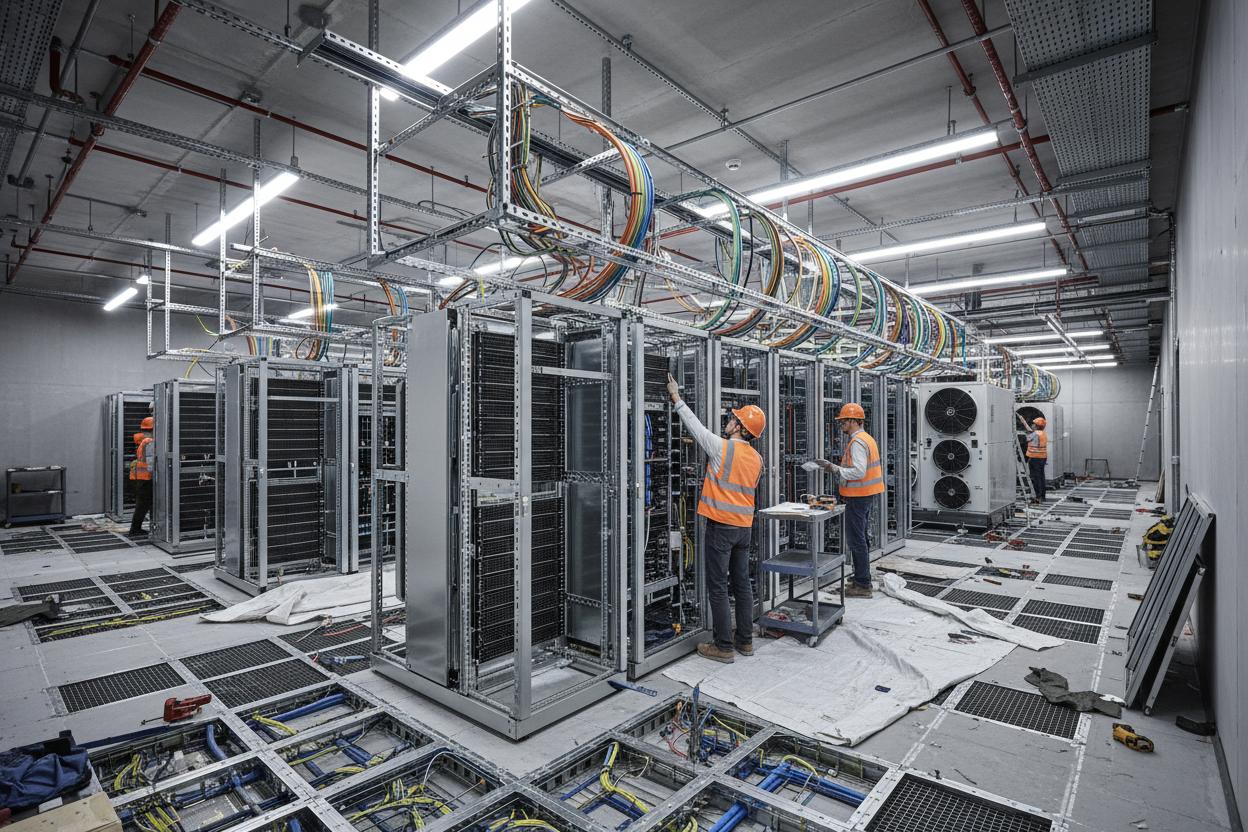
The largest spending is concentrated among cloud providers, semiconductor companies, technology platforms and AI developers building the infrastructure that everyone else uses.
Alphabet, Amazon, Microsoft, Meta and other technology companies are investing heavily in data centers, processors, networking and energy capacity. Stanford's AI Index notes that major cloud providers have accelerated capital expenditures, with Google reporting more than $150 billion in annual capital expenditures in 2025.
This creates a multiplier effect.
A bank might spend several million dollars on AI services. A cloud provider supporting thousands of banks, retailers and software companies may spend billions building the infrastructure those customers consume.
The same dollar can therefore be represented indirectly across multiple parts of the AI supply chain.
This is one reason it is misleading to simply divide a global AI-spending forecast by the number of companies and assume that represents the average corporate AI budget.
 How Much Are Ordinary Enterprises Spending?
The typical American company is spending dramatically less than a hyperscaler.
For a mid-sized company, AI spending may begin with software licenses costing tens or hundreds of dollars per employee each year. From there, costs can grow to hundreds of thousands or several million dollars when companies add customized applications, data integration, security controls, cloud consumption and professional services.
Large enterprises can spend tens or hundreds of millions of dollars.
The important distinction is that AI budget size increasingly depends on the complexity of the workflow rather than simply the number of employees.
Consider two hypothetical U.S. companies.
A 500-person professional-services firm may spend $150,000 to $400,000 annually on AI-enabled software, employee training and a small number of custom workflows. Its objective might be to reduce administrative work, accelerate proposal development and help employees research documents.
A national insurer with tens of thousands of employees could spend tens of millions of dollars integrating AI into claims processing, customer service, fraud detection, software development and document analysis.
Neither budget looks remotely like a hyperscaler's infrastructure investment. Both can represent serious AI spending relative to the company's size.
McKinsey's 2026 survey found that 28% of respondents said their organizations spend more than 10% of their total enterprise-wide ICT budget on AI technologies. At the same time, 20% reported that AI operating costs—including token-related costs—were constraining usage.
That second figure is particularly important.
The AI bill is no longer theoretical. Companies are discovering that once employees and automated systems use AI at scale, consumption costs can become a meaningful operating expense.
Where Is the Money Actually Going?The distribution of AI spending in 2026 provides a much better picture than a single headline number.
1. Data centers and computing infrastructureInfrastructure remains the largest spending category.
Companies need processors, servers, networking equipment, cooling systems, storage and electricity to train and operate increasingly capable models. Cloud providers are building capacity partly in anticipation of future enterprise demand.
Gartner forecasts worldwide AI-optimized infrastructure spending to reach about $42 billion for AI-optimized infrastructure-as-a-service in 2026, representing 96% growth through the year.
For businesses buying AI services from the cloud, this spending may be hidden inside a monthly infrastructure bill. For hyperscalers, it represents massive capital expenditure.
2. AI softwareAI software is becoming a mainstream corporate purchasing category.
Companies are paying for AI-enabled office productivity tools, enterprise search, coding assistants, customer-service systems, sales automation, marketing tools and industry-specific applications.
Gartner estimates worldwide AI software spending at roughly $453 billion in 2026.
The important trend is that AI is increasingly bundled into software businesses already use. Instead of purchasing a standalone “AI project,” companies may pay more for existing CRM, productivity, cybersecurity or development platforms that now include AI capabilities.
3. AI models and APIsModel usage is becoming a variable expense.
A company may start with a modest API bill while testing an application. Once the application reaches thousands or millions of users, token consumption can become substantial.
Gartner estimates worldwide spending on AI models and platforms will reach approximately $64.3 billion in 2026, up 63.4% from 2025. Foundation generative AI model spending is forecast to more than double.
This shift toward consumption-based spending changes budgeting. Companies can no longer always predict AI costs from the number of software seats alone.
4. AI implementation and consultingThe software itself is often only part of the expense.
Large companies need to connect AI systems to internal databases, security systems, customer records and legacy applications. They also need testing, monitoring and governance.
That creates demand for implementation partners and specialized employees.
5. Training, governance and risk managementAI introduces new compliance, privacy, security and model-risk considerations.
Organizations increasingly need policies governing which models employees can use, what information can be entered into AI systems, how outputs are validated and how automated decisions are monitored.
These costs do not always appear in AI software budgets, but they are part of the real cost of enterprise deployment.
Why 2026 Is Different From the Early Generative-AI Spending WaveThe first phase of corporate AI adoption was largely about experimentation.
Employees tried chatbots. Developers experimented with coding tools. Marketing departments generated content. Executives commissioned pilot projects.
The 2026 market is increasingly focused on operationalization.
McKinsey reports that 40% of respondents from organizations with more than $1 billion in annual revenue say they are scaling AI agents, compared with 27% the previous year. Smaller organizations remain at 22%.
This matters financially because an AI agent can consume more resources than a simple chatbot interaction.
A basic chatbot might answer one question.
An agent can retrieve information, call another application, generate a response, check the result, revise it and perform another action. Each step can consume compute, API calls and monitoring resources.
Consequently, companies are learning that AI costs are driven by workflow complexity and usage frequency, not just the number of employees given access to an AI tool.
Are Companies Actually Getting Their Money's Worth?This is where the 2026 data becomes more nuanced.
AI adoption is increasing faster than enterprise-wide financial returns.
McKinsey's latest global survey found that 80% of respondents say AI has improved their individual productivity, while 37% say AI has contributed to their organization's EBIT. The proportion of respondents qualifying as AI high performers remains around 6%.
That gap explains why CFOs are paying much closer attention to AI economics.
An employee might save 30 minutes a day using an AI assistant. That is useful, but it does not automatically translate into a 10% reduction in payroll.
The organization has to decide what happens to the recovered time.
Does the employee serve more customers? Produce more software? Close more sales? Complete more analysis? Or simply finish the same work earlier?
The financial outcome depends on what the company does with the productivity gain.
This is why workflow redesign is so important. McKinsey's earlier research found that redesigning workflows is strongly associated with greater bottom-line impact from generative AI.
 A Practical Example: What a $1 Million AI Budget Could Look Like
Imagine a U.S. company with 5,000 employees approving a $1 million AI program.
The company might allocate the budget roughly like this:
• $300,000 for enterprise AI software licenses
• $200,000 for cloud and model consumption
• $150,000 for data integration
• $125,000 for cybersecurity and governance
• $100,000 for employee training
• $75,000 for implementation consulting
• $50,000 for monitoring and evaluation
The exact numbers would vary enormously, but the structure demonstrates a crucial point: the model subscription is rarely the entire AI bill.
Suppose the company's main goal is customer-service automation.
If AI reduces average handling time by 10%, the company needs to determine whether that creates actual economic value. Perhaps it allows the business to handle more customers without adding staff. Perhaps it improves response times and customer retention. Or perhaps employees simply have more time for complex cases.
The $1 million investment should therefore be evaluated against measurable business outcomes—not against the number of AI tools deployed.
Why AI Budgets Are Growing Even When ROI Is Still UncertainIt may seem contradictory that companies continue increasing AI investment while relatively few report major enterprise-level financial impact.
There are several reasons.
First, companies increasingly view AI as a strategic capability rather than an optional experiment. McKinsey's 2026 technology research found AI has surpassed cybersecurity and infrastructure modernization as the top technology investment priority among surveyed companies. Half identified AI as a priority investment area.
Second, companies are worried about falling behind competitors.
Third, AI capabilities are becoming embedded in software that companies already purchase. The decision is therefore sometimes less about “Should we buy AI?” and more about “Which AI-enabled version of our existing technology should we use?”
Fourth, companies are investing in infrastructure and skills before they know exactly which use cases will produce the largest returns.
This is similar to previous technology transitions. Businesses often build capability before the final winning applications become obvious.
Which U.S. Industries Are Spending the Most?Technology companies remain among the largest AI investors, but AI spending is spreading rapidly into other industries.
Financial services have strong incentives to use AI for fraud detection, customer service, software development, risk analysis and document processing.
Healthcare companies are investing in clinical documentation, administrative automation, research and operational analytics.
Retailers are applying AI to forecasting, customer service, merchandising, marketing and supply-chain operations.
Manufacturers are using AI for quality control, predictive maintenance, engineering and industrial automation.
Professional-services firms are using AI for research, document review, coding, analysis and client deliverables.
McKinsey's 2026 survey found that respondents in pharmaceuticals and medical products, insurance, and banking and other financial institutions were among the most likely to expect AI investment to increase over the following year.
The spending pattern therefore increasingly follows business opportunity rather than technology-sector boundaries.
What About Small Businesses?Small businesses are participating in the AI economy, but their spending model looks very different.
A small U.S. company may not need its own AI infrastructure or a dedicated AI department. Instead, it may use AI features already included in software it purchases.
A 20-person marketing agency, for example, might use AI for research, first drafts, meeting summaries, client reporting and data analysis without creating a separate million-dollar AI budget.
The cost could be measured in hundreds or a few thousand dollars per month rather than millions per year.
For small businesses, the bigger challenge is often not finding an AI tool. It is selecting a small number of tools that employees will actually use consistently.
The Hidden Cost: AI Infrastructure, Electricity and Data CentersOne of the most consequential aspects of the 2026 AI boom is that AI spending increasingly has a physical footprint.
AI models require computing infrastructure, and computing infrastructure requires electricity, cooling, networking and real estate.
That has turned energy availability into an increasingly important business issue for AI infrastructure developers.
Reuters reported in September 2026 that AI-linked debt issuance had approached $500 billion in the U.S. high-grade debt market, while financing conditions for data-center construction had become more cautious because of power constraints, supply-chain disruptions and regulatory delays.
This is another reason the AI spending story should not be reduced to software subscriptions.
Behind every large AI workload is a physical infrastructure chain.
Are Companies Cutting Other Technology Spending to Fund AI?In some cases, yes.
AI budgets are increasingly competing with traditional technology investments.
McKinsey's 2026 research on technology budgets describes CIOs balancing “run” spending—keeping existing systems operating—with “change” spending that creates new capabilities. AI adds pressure because companies need to fund both existing infrastructure and new AI systems.
Some organizations may postpone lower-priority software projects, consolidate vendors or redirect cloud budgets toward AI.
The strategic question is not necessarily whether AI deserves more money. It is whether AI deserves more money than the next-best alternative investment.
That is a much more useful way for executives to think about the issue.
What Should Companies Measure Before Increasing AI Spending?Businesses should avoid treating AI spending as a technology vanity metric.
The most useful measurements are connected to business outcomes.
For a customer-service deployment, companies might track cost per interaction, resolution time, escalation rates and customer satisfaction.
For software development, they might measure cycle time, defect rates, deployment frequency and engineering throughput.
For sales, they might track qualified opportunities, conversion rates, response time and revenue per representative.
For internal knowledge systems, they could measure search time, task completion time and employee adoption.
The central principle is simple: measure the workflow before and after AI deployment.
A company that spends $2 million on AI but cannot explain what changed operationally has a budgeting problem, regardless of how advanced its technology appears.
What Does the AI Spending Boom Mean for U.S. Workers?AI spending does not automatically mean mass layoffs.
McKinsey's 2026 survey found that 39% of respondents expect AI-related declines in employment over the coming year, but only 14% reported actual AI-related workforce reductions over the previous year. Two-thirds reported little or no AI-related change in total employment.
That suggests the near-term impact is more complicated than replacing workers one-for-one.
Companies can use AI to increase output from existing teams, reduce hiring needs, eliminate certain tasks, or redirect employees toward higher-value activities.
The financial effect depends heavily on the organization's operating model.
A company that simply adds AI on top of existing processes may increase costs.
A company that redesigns work around AI may achieve much larger gains.
What the 2026 Numbers Really Tell UsThe most important conclusion is not that American companies are spending a particular number of billions on AI.
It is that AI spending is becoming layered.
At the top of the market, U.S. technology companies are committing extraordinary amounts of capital to computing infrastructure.
Below them, enterprises are increasing spending on software, models, cloud capacity and implementation.
At the employee level, AI is becoming embedded into everyday tools.
And underneath all of it, companies are developing new governance, security, data and workforce capabilities.
Gartner's forecasts make clear that infrastructure remains the largest component of global AI spending, while its latest research on models and platforms shows enterprise buyers increasingly scrutinizing cost, latency, performance and reliability.
The next stage of the market will therefore be less about who can spend the most and more about who can turn spending into measurable business performance.
The 2026 AI spending boom is real, but the most useful question for a U.S. company is not whether competitors are spending billions.
It is whether its own AI investments are producing better economics.
The organizations most likely to benefit are not necessarily those with the largest budgets. They are the companies that understand where AI creates measurable value, redesign the surrounding workflow, control usage costs and build the governance required to scale responsibly.
AI is becoming a permanent part of corporate technology budgets. That does not make every AI project a good investment.
The discipline required in 2026 is straightforward: spend where the economics work, measure what changes, and scale only when the evidence supports it.
Stay in the Loop



You May Also Like
 Cybersecurity 3 min read| 18 Aug 2026
The Rise of AI: How Artificial Intelligence is Shaping the Future
Artificial Intelligence (AI) has emerged as one of the most transformative technologies of our era. With the capability to analyze vast amounts of data, learn from it, and make decisions with minimal human intervention, AI is revolutionizing industries and reshaping the way we live, work, and interact. This article explores the significant impact of AI across various sectors and its potential to drive future innovations.
AI & Automation 12 min read| 12 Sep 2026How Much Are U.S. Companies Really Spending on AI in 2026? The Numbers Behind the AI Spending Boom
U.S. companies are spending more on AI in 2026, but the biggest numbers are concentrated in cloud infrastructure, chips, data centers, software, and services rather than simple AI subscriptions. Enterprise budgets are rising, yet many businesses remain focused on measurable productivity and cost savings. The key question is no longer whether companies spend on AI, but where and why.
 IOT & Blockchain 7 min read| 07 Jul 2026
Tokenomics: Understanding the Economics of Cryptocurrencies
Welcome to the world of tokenomics! In recent years, cryptocurrencies have revolutionized the way we think about money, finance, and economics. Tokenomics, short for token economics, refers to the study of the economic principles and mechanisms underlying cryptocurrencies and blockchain-based tokens. In this article, we'll explore the key concepts of tokenomics and how they shape the economics of cryptocurrencies.
 IOT & Blockchain 5 min read| 22 Jun 2026
Exploring Private Keys and Their Importance in Cryptocurrency Security
Private keys are fundamental to cryptocurrency security, serving as the gateway to access and control digital assets stored on blockchain networks. Unlike public keys used for transactions, private keys must be kept confidential and secure to prevent unauthorized access and potential loss of funds.