Can AI Agents Actually Replace Business Software in 2026? What the “SaaSpocalypse” Debate Gets Right—and Wrong
AI agents are changing how businesses buy, build, and use software, but they are unlikely to replace most business applications outright in 2026. The bigger shift is from employees operating software manually to agents operating software on their behalf. The SaaSpocalypse debate correctly identifies pressure on traditional SaaS, but underestimates data, governance, integrations, reliability, and enterprise switching costs.
Introduction: The Question Behind the “SaaSpocalypse”For years, the standard business-software model was straightforward: a company bought software, employees logged into it, and the organization paid a recurring fee for every user. Customer relationship management lived in a CRM. Accounting lived in an accounting platform. Human resources lived in an HR system. Project management lived in a project-management application.
AI agents challenge that model because they change who—or what—actually operates the software.
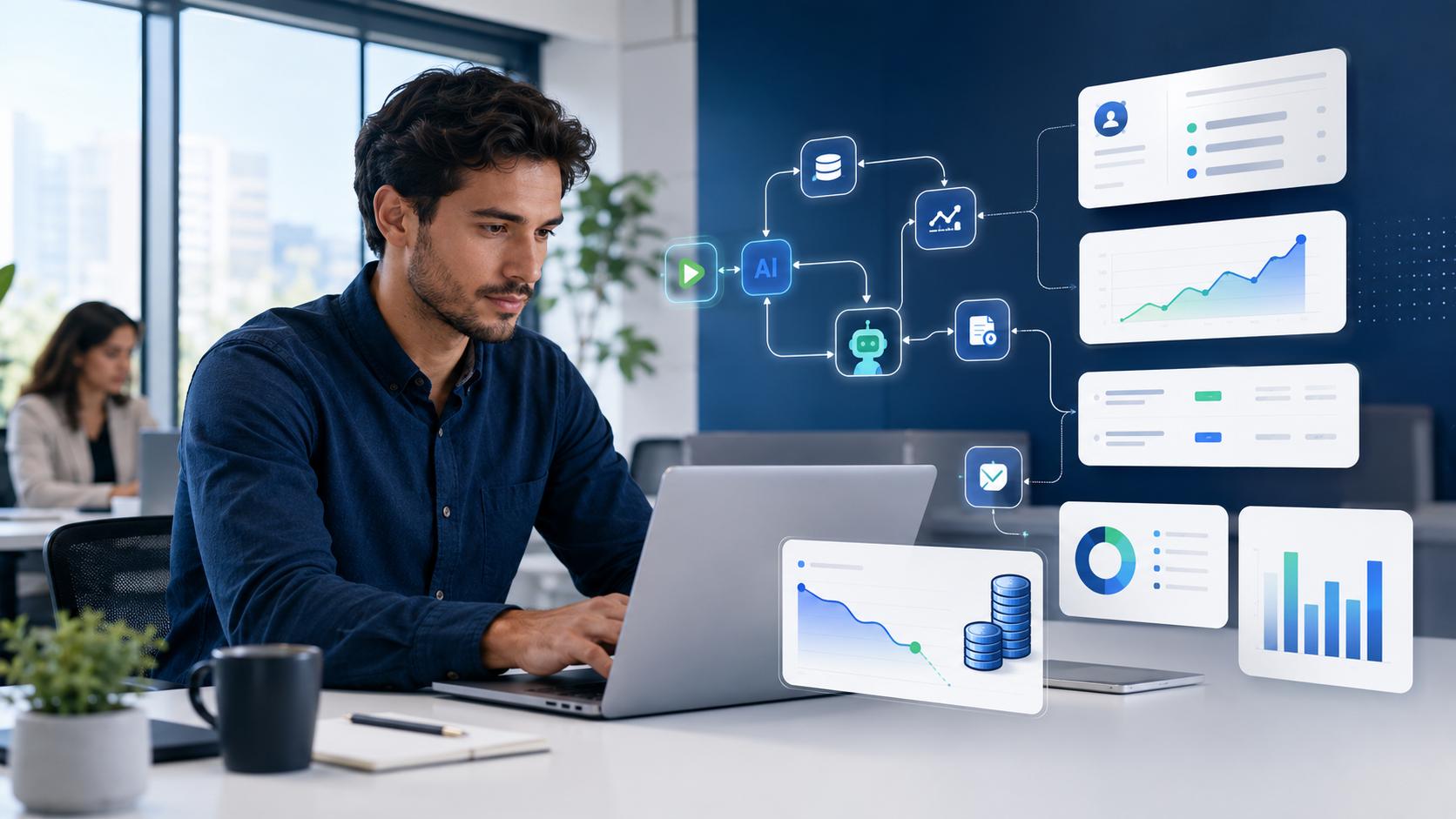
Instead of a salesperson opening a CRM, finding a customer record, updating an opportunity, drafting a follow-up and scheduling a meeting, an agent could potentially perform the entire workflow. Instead of an employee manually moving information between applications, an agent could interpret an instruction, retrieve data, make decisions within defined limits and execute actions across multiple systems.
That distinction explains why 2026 has produced so much discussion about a potential “SaaSpocalypse.” The term refers broadly to the idea that increasingly capable AI agents—and especially AI coding agents—could reduce the need for traditional software products. The debate intensified as companies began considering whether certain applications were easier to build internally than purchase from vendors.
There is real substance behind the argument. McKinsey's 2026 global AI research found that 32% of respondents said their organizations had decided against buying at least one software product or feature because they believed they could build it internally with agentic coding tools. At large organizations, 40% reported scaling AI agents, compared with 27% a year earlier.
But “software can be generated by AI” is not the same as “business software no longer matters.”
The more likely outcome is considerably more nuanced: AI agents will change the economic value of software, compress some software categories, expand others, and increasingly turn applications into infrastructure that agents operate rather than interfaces humans use directly.
What Exactly Is an AI Agent?An AI assistant generally responds to a person. An AI agent is designed to pursue a goal and take actions using tools, systems and information.
The distinction is important.
If an employee asks an AI assistant, “Summarize our top five sales opportunities,” the system may retrieve information and produce an answer.
An agent might receive a higher-level instruction such as, “Review this quarter's pipeline, identify deals at risk, research the accounts, prepare recommended next steps and create follow-up tasks for the sales team.”
The second workflow involves multiple steps and potentially multiple systems.
In practical business terms, an agent usually needs access to some combination of:
- Company databases
- SaaS applications
- APIs
- Internal documents
- Communication systems
- Business rules
- Authentication and permissions
- Monitoring and audit systems
That last group is frequently overlooked in discussions about software replacement.
An agent that can produce a persuasive answer is useful. An agent that can safely change a customer's contract, issue a refund, modify payroll or approve a purchase order requires a substantially higher standard.

What Happens When Your AI Agent Gets Access to Your Email, Files and Apps? The New Security Problem Businesses Need to Understand
ChatGPT vs. Claude for Work: Which AI Is Actually Better for U.S. Businesses in 2026?
How Much Are U.S. Companies Really Spending on AI in 2026? The Numbers Behind the AI Spending Boom
AI Agents vs. AI Assistants: What’s the Difference—and Which One Should Your Business Use in 2026?
The SaaSpocalypse thesis is based on a legitimate economic observation: software has historically been valuable partly because building customized software was expensive.
If AI dramatically lowers the cost of creating software, the build-versus-buy calculation changes.
Imagine a 200-person U.S. company paying $40,000 a year for a specialized internal workflow application. Historically, building an alternative might have required engineers, designers, product managers, infrastructure and months of work.
Now imagine a small internal team using coding agents to produce a customized version in weeks.
The question changes from:
“Why would we build software when the vendor already has it?”
to:
“Why should we keep paying for software that doesn't perfectly fit our workflow if we can build and maintain a tailored version ourselves?”
That is a meaningful threat to some SaaS categories.
It also creates competitive pressure on vendors whose primary advantage is simply that they provide a convenient interface around relatively straightforward functionality.
The pressure is particularly relevant for software that has:
- Limited differentiation
- Simple workflows
- Relatively shallow integrations
- Low regulatory requirements
- Small numbers of users
- Highly customizable business processes
- Relatively low switching costs
A lightweight internal dashboard, approval workflow or specialized reporting tool may increasingly be difficult to justify as a standalone SaaS subscription if an organization can create something sufficiently good itself.
That does not mean every SaaS company is doomed.
It means software vendors may have to earn their place in the stack differently.
💡 Discover More from AI & Automation

AI & Automation
The Future of Generative AI in Creative Industries

AI & Automation
Machine Learning in Healthcare: Transforming Diagnosis and Treatment

AI & Automation
How Artificial Intelligence Is Redefining Workplace Productivity

AI & Automation
The Challenges of Bias in AI: Can Machine Learning Ever Be Truly Fair?
The most vulnerable software is not necessarily the software with the highest price. It is software whose primary value comes from presenting a relatively straightforward workflow through a graphical interface.
Consider a hypothetical marketing team.
Today, employees might use separate applications for:
1. Campaign planning
2. Content production
3. Competitive research
4. Analytics
5. Reporting
6. Task management
An AI-driven workflow could potentially consolidate several of these activities.
A manager might say:
“Analyze our paid-search performance from the last 30 days, identify campaigns where customer acquisition costs increased materially, compare performance with the previous period, summarize likely causes, draft recommendations and create tasks for the campaign owners.”
The agent could retrieve advertising data, examine analytics, inspect internal notes, generate a report and create assignments.
The user does not need to understand which individual application performed each step.
That creates an important strategic possibility: the interface becomes less important than the underlying capability.
Instead of employees moving between ten applications, employees increasingly tell an AI system what outcome they want.
This is one reason software companies are redesigning their products around agents rather than treating AI as merely another chatbot feature. Deloitte's research describes agentic automation as a way to handle more dynamic processes than traditional rule-based automation, while emphasizing that human oversight remains important.
The More Important Change: Software May Become InfrastructureThe most useful way to understand the future is not “AI versus SaaS.”
It is agents on top of software infrastructure.
A company's CRM may continue to store customer records even if salespeople rarely open the CRM themselves.
An accounting platform may continue to maintain the financial ledger even if agents prepare reconciliations and reports.
An HR platform may continue to contain employee records, payroll data and compliance workflows even if employees interact with it primarily through an AI interface.
In this model, the software survives—but its user interface becomes less central.
This is a crucial distinction.
A business application often performs at least four different jobs:
- It stores authoritative data.
- It enforces business rules.
- It provides permissions and access controls.
- It gives people a way to perform work.
AI agents may reduce the importance of the fourth function while increasing the importance of the first three.
That could actually make certain enterprise software platforms more strategically important, not less.
What the SaaSpocalypse Debate Gets Right1. AI Is Changing the Build-versus-Buy EquationThis is probably the strongest part of the argument.
For years, software purchasing was partly a response to engineering scarcity. Companies bought applications because internal development was too expensive or slow.
Agentic coding changes the economics of small and medium-sized software projects.
A company may still choose SaaS, but it has a credible alternative that did not exist at the same cost a few years ago.
This creates pricing pressure.
It also creates competitive pressure on vendors whose primary advantage is simply that they provide a convenient interface around relatively straightforward functionality.
2. Per-Seat Pricing Is Under PressureTraditional SaaS pricing frequently depends on the number of people using a product.
But an AI agent can potentially perform work on behalf of dozens or hundreds of employees.
If one agent performs the work previously performed by 20 employees inside a software application, charging strictly according to human seats becomes harder to justify.
This is why the industry is experimenting with consumption-based, outcome-based and agent-oriented pricing models.
The underlying question is changing from:
“How many people use our software?”
to:
“How much valuable work does our system perform?”
That is a profound change in SaaS economics.
3. Simple Point Solutions Face Real RiskA company selling a narrow application that solves one uncomplicated workflow may have less protection than a platform deeply embedded in an organization's operations.
If an agent can replicate the core functionality cheaply, the customer may reasonably ask why it needs another subscription.
That doesn't mean every point solution disappears. Specialized expertise, reliability, integrations and compliance can still provide strong defensibility.
But the burden of proof is increasing.
 What the SaaSpocalypse Debate Gets Wrong1. Writing Software Is Not the Same as Running a Business
This is perhaps the biggest misconception.
An AI coding agent can generate a working application.
That does not automatically mean the application is production-ready.
Businesses need software to handle authentication, data migrations, backups, permissions, monitoring, security, compliance, uptime, incident response, integrations, versioning and maintenance.
The software itself may be the easy part.
The operational environment is often the hard part.
This is one reason the current AI disruption may be less dramatic than the most aggressive SaaSpocalypse predictions suggest. Established enterprise software remains resilient partly because corporate systems involve extensive integrations, maintenance requirements and organizational inertia.
2. Enterprise Data Is MessyAn agent can only be as effective as the information it can access.
Large American companies often have decades of accumulated data spread across ERP systems, CRMs, data warehouses, spreadsheets, email, file systems and custom applications.
The problem is not simply connecting to those systems.
It is understanding which information is authoritative.
Consider a customer whose name appears differently in three systems, whose account ownership changed twice and whose contract contains exceptions not represented in the CRM.
An agent needs context.
Enterprise software often exists precisely because companies need controlled systems of record.
3. Reliability Matters More Than IntelligenceA human employee can notice when something looks wrong.
An autonomous system can potentially make the same mistake repeatedly.
Suppose an agent incorrectly interprets a customer's cancellation request. If it merely drafts an email, the damage may be small.
If it automatically cancels the customer's service, issues a refund and changes accounting records, the consequences become much larger.
This is why agentic systems require permissions, approval thresholds, audit trails and monitoring.
Deloitte reported in 2026 that only 21% of surveyed organizations had mature governance models for agentic AI, even as adoption was accelerating.
That gap is significant.
Why Enterprise Software May Actually Become More ValuableThis seems contradictory, but it is one of the most important ideas in the entire debate.
Imagine an AI agent that needs to determine whether a customer is eligible for a refund.
Where does it obtain the customer record?
Where does it find the contract?
Where does it retrieve the payment history?
Where does it determine the company's refund policy?
Where does it record the final decision?
Those systems are not necessarily made obsolete by the agent.
They become the agent's source of truth and execution layer.
In other words, the agent may sit above the software rather than replace it.
The best enterprise software companies therefore have an opportunity to become platforms for machine-operated work.
The winners may be the vendors that provide clean data, robust APIs, reliable workflows, permissions, auditability and increasingly capable agent interfaces.
A Realistic Example: A 500-Person U.S. CompanyConsider a hypothetical 500-person manufacturer headquartered in Ohio.
The company uses an ERP platform for inventory and finance, a CRM for sales, an HR platform for employee information, a ticketing system for IT and several specialized tools.
Management wants to reduce administrative work.
The unrealistic approach would be:
“Let's replace all our SaaS applications with AI agents.”
The realistic approach would be:
“Let's identify which workflows currently require employees to move information between those systems.”
Suppose the order-management process requires employees to check inventory, verify customer status, confirm pricing, review shipping constraints and update multiple systems.
An agent could potentially coordinate that process.
The company may reduce manual work substantially without replacing the ERP or CRM.
The economic value comes from eliminating repetitive human interaction with software—not necessarily eliminating the software itself.
That is likely to be the dominant pattern in 2026.
Which Business Software Categories Are Most Exposed?Not all SaaS products face equal AI pressure.
Higher exposureSoftware is more exposed when it:
- Automates relatively simple knowledge workflows
- Has limited proprietary data
- Has few deep integrations
- Can be replicated internally
- Offers primarily a user interface
- Has high per-seat pricing relative to its functionality
Lower exposureSoftware is more defensible when it:
- Acts as a system of record
- Handles regulated processes
- Has deep enterprise integrations
- Manages complex permissions
- Provides proprietary datasets
- Requires high reliability
- Has substantial switching costs
- Embeds sophisticated business rules
The distinction is more useful than asking whether “SaaS” as a category is dead.
It isn't.
But the value distribution inside SaaS is likely to change.
What Small and Mid-Sized Businesses Should Do in 2026For a small or midsize U.S. company, the wrong response is to cancel software subscriptions simply because an AI agent can theoretically reproduce some of their functionality.
Instead, businesses should audit workflows.
Start by identifying where employees spend time operating software rather than doing work that directly creates value.
Look for repetitive activities involving copying, searching, updating, reconciling, summarizing or routing information.
Then ask whether an agent can safely automate part of the workflow.
A practical sequence looks like this:
- Identify one measurable workflow.
- Document the current process.
- Calculate the human time involved.
- Identify the systems and data involved.
- Determine what decisions require human approval.
- Test an agent in a limited environment.
- Measure accuracy and time savings.
- Expand only after reliability is demonstrated.
This approach avoids both extremes: blindly trusting AI and refusing to use it.
What Should Companies Measure?The number of deployed agents is not a meaningful business metric by itself.
A company could deploy 100 agents and accomplish very little.
Instead, measure outcomes.
Useful metrics include:
- Hours of employee time eliminated
- Cost per completed workflow
- Error rates
- Human-review rates
- Cycle time
- Customer response time
- Revenue generated
- Revenue protected
- Software costs avoided
- Incident frequency
- Agent failure recovery time
This is especially important because organizations remain early in the transition.
McKinsey's 2025 research found that 62% of respondents said their organizations were at least experimenting with AI agents, but nearly two-thirds had not yet begun scaling AI across the enterprise.
That gap between experimentation and enterprise-scale deployment remains one of the most important realities behind the agentic-AI conversation.
Will AI Agents Replace SaaS in 2026?For most businesses, no—not broadly.
But they are likely to replace some software workflows, reduce usage of certain applications, eliminate some point solutions and change how companies evaluate software purchases.
The more important transformation is that employees may increasingly stop thinking about software as a collection of destinations.
Instead of:
“Open Salesforce.”
“Check Jira.”
“Look in the ERP.”
“Search the knowledge base.”
The future workflow may become:
“Find the issue, determine the cause, propose the resolution and update the appropriate systems.”
The agent becomes the interface.
The underlying applications become infrastructure.
That is a very different software market, even if many of today's major applications remain in place.
The 2026 SaaS Buyer Has a New QuestionHistorically, buyers asked:
“Does this software have the features we need?”
Increasingly, they should ask:
“What part of this workflow genuinely requires this software?”
That question can expose unnecessary applications.
It can also reveal why some software is incredibly valuable.
A CRM with a beautiful interface but weak data infrastructure may be vulnerable.
A CRM with reliable customer data, powerful APIs, granular permissions, strong integrations and a robust automation layer may become even more valuable when thousands of AI agents need access to customer information.
The same principle applies to ERP, HR, finance, customer service and other enterprise categories.
AI does not eliminate the need for infrastructure.
It changes who interacts with it.
The most plausible future is not a world where business software disappears overnight.
It is a world where people increasingly stop operating software directly.
That distinction matters.
The Salesforce record may still exist. The ERP may still process the transaction. The HR platform may still hold employee data. The accounting system may still maintain the books.
But the person doing the work may increasingly communicate with an agent instead of navigating each application manually.
The SaaSpocalypse debate gets something fundamentally right: AI is changing the economics of software.
Where it goes too far is assuming that changing the interface means eliminating the infrastructure.
In 2026, the smartest business strategy is therefore neither “buy every AI agent” nor “replace every SaaS application.”
It is to identify which parts of the software stack create durable value—and which parts exist mainly because humans have historically had to operate computers one screen at a time.
Stay in the Loop



You May Also Like
 Cybersecurity 3 min read| 18 Aug 2026
The Rise of AI: How Artificial Intelligence is Shaping the Future
Artificial Intelligence (AI) has emerged as one of the most transformative technologies of our era. With the capability to analyze vast amounts of data, learn from it, and make decisions with minimal human intervention, AI is revolutionizing industries and reshaping the way we live, work, and interact. This article explores the significant impact of AI across various sectors and its potential to drive future innovations.
 AI & Automation 12 min read| 12 Sep 2026
How Much Are U.S. Companies Really Spending on AI in 2026? The Numbers Behind the AI Spending Boom
U.S. companies are spending more on AI in 2026, but the biggest numbers are concentrated in cloud infrastructure, chips, data centers, software, and services rather than simple AI subscriptions. Enterprise budgets are rising, yet many businesses remain focused on measurable productivity and cost savings. The key question is no longer whether companies spend on AI, but where and why.
 IOT & Blockchain 7 min read| 07 Jul 2026
Tokenomics: Understanding the Economics of Cryptocurrencies
Welcome to the world of tokenomics! In recent years, cryptocurrencies have revolutionized the way we think about money, finance, and economics. Tokenomics, short for token economics, refers to the study of the economic principles and mechanisms underlying cryptocurrencies and blockchain-based tokens. In this article, we'll explore the key concepts of tokenomics and how they shape the economics of cryptocurrencies.
 IOT & Blockchain 5 min read| 22 Jun 2026
Exploring Private Keys and Their Importance in Cryptocurrency Security
Private keys are fundamental to cryptocurrency security, serving as the gateway to access and control digital assets stored on blockchain networks. Unlike public keys used for transactions, private keys must be kept confidential and secure to prevent unauthorized access and potential loss of funds.