Tokenized Assets Are Coming to Wall Street: What Does “Tokenization” Actually Mean for U.S. Investors?
Tokenization means representing an investment asset—such as a stock, Treasury, fund share, or other security—with a digital token recorded on blockchain or another distributed ledger. For U.S. investors, the important issue is not the technology itself, but what the token legally represents, who safeguards the underlying asset, what rights investors receive, and how trading works.
## Tokenization Is Moving From Crypto Experiments Into Traditional Finance
For years, blockchain discussions were largely associated with Bitcoin, cryptocurrency exchanges, NFTs, and decentralized finance. Wall Street largely watched from the sidelines. That distinction is becoming harder to maintain.
In 2026, some of the biggest pieces of U.S. financial-market infrastructure are actively working on tokenization. The Depository Trust & Clearing Corporation, or DTCC, has already processed production trades involving tokenized securities through its DTC tokenization initiative. DTCC says its service is scheduled for broader launch in October 2026, following successful July transactions involving equities, U.S. Treasuries, collateral, securities lending and other workflows.
That development matters because DTCC sits at the center of the U.S. securities infrastructure. Its subsidiaries processed securities transactions valued at approximately $4.7 quadrillion in 2025, according to DTCC.
But “tokenization” can sound more revolutionary than it actually is.
A token does not automatically transform a stock into a cryptocurrency. It does not necessarily eliminate brokers, custodians, regulators or exchanges. And buying something described as a “tokenized stock” does not necessarily mean you own the same legal rights as someone holding the company's conventional shares.
The Securities and Exchange Commission has explicitly emphasized this distinction. In its January 2026 statement, the SEC described a tokenized security as a security represented or formatted as a crypto asset, with ownership records maintained wholly or partly through crypto networks. It also distinguished between issuer-sponsored tokenization and third-party tokenized products.
For U.S. investors, that distinction is the starting point for understanding the entire subject.
What Does Tokenization Actually Mean?At its simplest, tokenization is the process of creating a digital representation of an asset or ownership interest on a blockchain or another distributed ledger.
Think about a traditional stock certificate, except modern securities generally do not involve physical certificates. Your ownership is recorded electronically through a complex network of brokers, custodians, transfer agents, clearing organizations and other market infrastructure.
Tokenization changes where and how some of those records are maintained.
Instead of relying entirely on conventional databases, a token can represent an asset or an entitlement associated with that asset on a blockchain or distributed ledger. The token can then potentially be transferred using blockchain-based infrastructure, subject to applicable rules and restrictions.
That creates several possible advantages.
But there is an important caveat: **the token is only as meaningful as the legal and financial relationship behind it.**
Imagine that a company has 1,000 shares outstanding. A platform creates 1,000 digital tokens that supposedly correspond to those shares.
That alone does not answer the most important questions.
Who legally owns the shares?
Where are they held?
Does the token holder receive voting rights?
Does the investor receive dividends?
What happens if the token issuer becomes insolvent?
Can the investor redeem the token for the underlying security?
Who maintains the authoritative ownership record?
Those questions can produce dramatically different answers depending on the tokenization structure.
The SEC's 2026 framework recognizes this complexity and identifies issuer-sponsored, custodial and synthetic models, among others.
Why Is Wall Street Interested in Tokenization?The appeal is less about replacing Wall Street than improving parts of the financial plumbing underneath it.
Today's securities markets involve many separate steps. A trade can require matching, clearing, settlement, custody, recordkeeping, reconciliation, collateral management and reporting. Different institutions may maintain different records and systems.
Tokenization could allow some of those processes to become more integrated.
For example, suppose an institutional investor owns $50 million of Treasury securities and wants to use them as collateral.
Under conventional infrastructure, moving that collateral between institutions can involve multiple intermediaries and operational processes.
A tokenized representation could potentially make the asset easier to transfer or pledge within compatible digital infrastructure.
This is one reason DTCC has emphasized **collateral mobility** as a major use case. Its July 2026 production tests included collateral pledges, securities lending, Treasury repo delivery-versus-payment transactions and equity transactions.
The potential benefits include:
- Faster settlement and transfer processes
- More automated reconciliation
- Greater collateral mobility
- Extended trading availability
- Programmable transaction rules
- Potentially lower operational costs
- Easier integration between traditional and digital financial infrastructure
None of these benefits are guaranteed.
A blockchain does not automatically make an inefficient financial process efficient. If the surrounding legal, custody and compliance infrastructure remains complicated, tokenization may simply create another technological layer.
That is why institutional tokenization is increasingly focused on **market architecture**, not simply putting assets on a blockchain. The SEC's August 2026 institutional tokenization analysis similarly emphasizes legal enforceability, custody, authoritative records and operational resilience.
What Happens When Your AI Agent Gets Access to Your Email, Files and Apps? The New Security Problem Businesses Need to Understand
ChatGPT vs. Claude for Work: Which AI Is Actually Better for U.S. Businesses in 2026?
How Much Are U.S. Companies Really Spending on AI in 2026? The Numbers Behind the AI Spending Boom
Can AI Agents Actually Replace Business Software in 2026? What the “SaaSpocalypse” Debate Gets Right—and Wrong
This is probably the most important question an individual investor can ask about tokenized assets.
Consider two hypothetical products.
### Product A: Issuer-sponsored tokenized stock
A public company authorizes a blockchain-based version of its shares. The token is integrated into the company's official ownership infrastructure, and the holder receives the same economic and corporate rights associated with the relevant class of shares.
Here, tokenization primarily changes the **format and infrastructure** through which ownership is recorded and transferred.
### Product B: Third-party tokenized stock exposure
A separate financial company holds conventional shares or otherwise structures an instrument linked to a public company's stock. It then issues tokens representing an interest, entitlement or synthetic exposure connected to those shares.
The investor may benefit from changes in the stock price, but the token may not provide the same voting, dividend, bankruptcy or shareholder rights.
The SEC specifically warns that third-party tokenized securities can expose investors to risks involving the third party, including bankruptcy and contractual risks that the owner of the underlying security might not face.
This distinction is already becoming relevant to U.S. retail investors.
The SEC's Investor Advisory Committee has noted that “wrapped” tokenized equity can involve a custodied underlying security, while a native tokenized security can be issued directly on a blockchain. The committee also highlighted that investors in wrapped third-party products may not have the same voting or bankruptcy rights as investors holding native securities.
In other words, **two products can both be marketed as “tokenized Apple stock” or “tokenized equities” while giving investors materially different legal rights.**
The name is not enough.
💡 Discover More from IOT & Blockchain

AI & Automation
AI Agents vs. AI Assistants: What’s the Difference—and Which One Should Your Business Use in 2026?

AI & Automation
The Future of Generative AI in Creative Industries

AI & Automation
Machine Learning in Healthcare: Transforming Diagnosis and Treatment

AI & Automation
How Artificial Intelligence Is Redefining Workplace Productivity
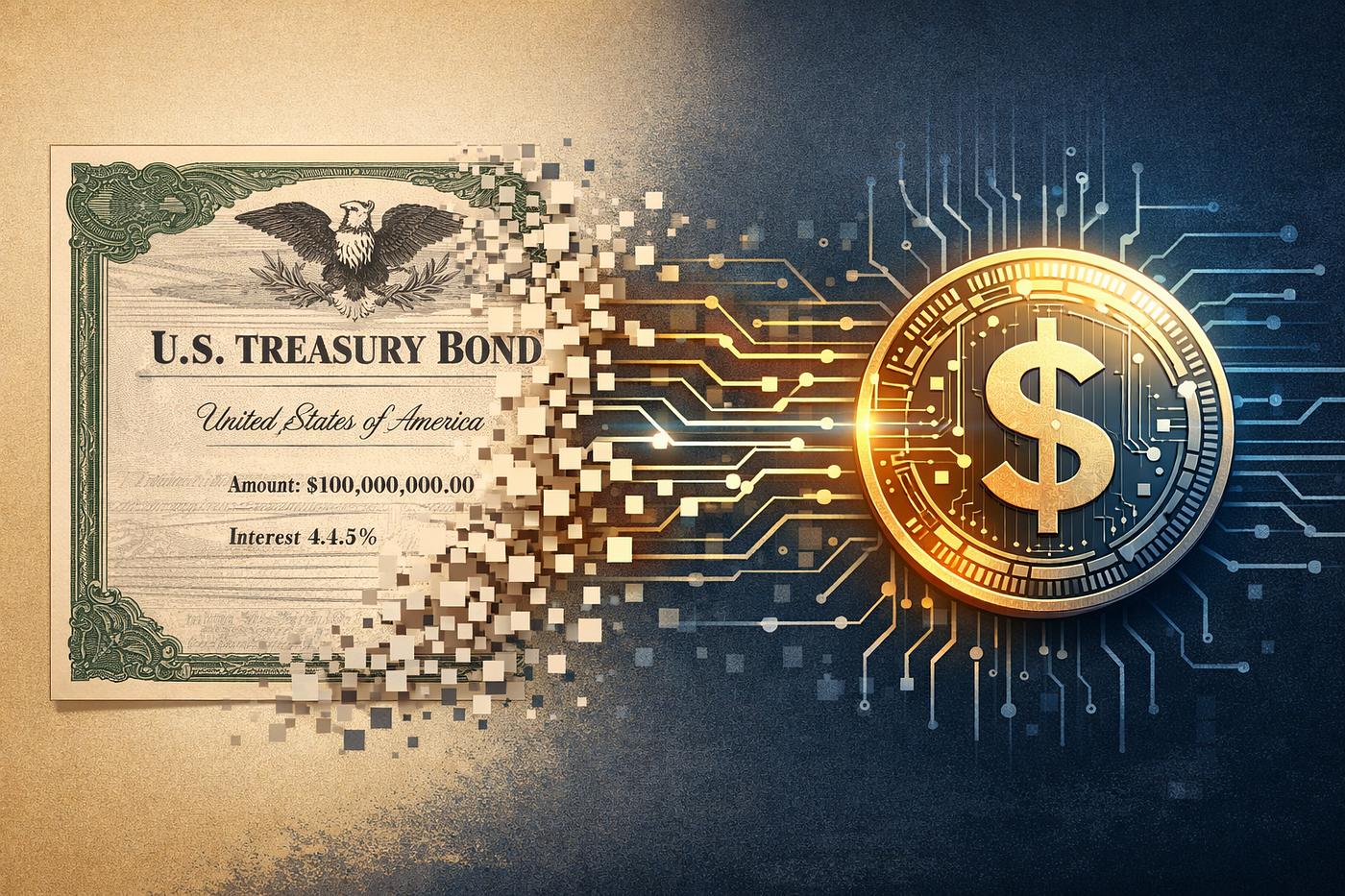
If you want to understand where tokenization may be most practical, U.S. government securities provide a useful example.
Tokenized Treasury products have become one of the largest real-world asset categories in the blockchain market.
RWA.xyz data showed approximately **$15.74 billion of distributed value in tokenized U.S. Treasury funds as of September 12, 2026**, covering Treasury bills, notes, bonds and Treasury-focused funds. The platform listed 25 products and more than 74,000 holders.
That does not mean $15.74 billion of Treasuries have magically moved onto a blockchain. Rather, it represents Treasury-related assets or fund interests represented within tokenized structures.
This is an important distinction.
For example, a tokenized money-market fund may hold short-term government securities in conventional custody while issuing blockchain-based fund shares.
The investor is not necessarily holding a Treasury bill directly.
Instead, the investor may hold a tokenized share of a regulated fund that invests in Treasuries.
Franklin Templeton's Benji platform is one example of this broader model. In 2026, Franklin Templeton announced an institutional program allowing eligible clients to use tokenized money-market-fund shares as off-exchange collateral in digital markets, while the underlying assets remain in regulated custody.
For investors, this illustrates a broader lesson:
**Tokenization does not eliminate the traditional financial system. In many cases, it connects blockchain infrastructure to traditional custody, funds and securities.**
For example, a tokenized money-market fund may hold short-term government securities in conventional custody while issuing blockchain-based fund shares.
What Is DTCC Doing With Tokenization?DTCC's work may be one of the most important developments for U.S. investors because it involves existing securities-market infrastructure rather than a standalone crypto startup.
In December 2025, DTC received an SEC no-action letter covering a new tokenization service for certain DTC-custodied assets. The authorized scope includes securities associated with the Russell 1000, major-index ETFs and U.S. Treasury bills, notes and bonds, subject to the conditions of the program.
In July 2026, DTCC announced that tokenized DTC-held securities had successfully been used in real production trades.
Those transactions included:
- U.S. Treasury repo
- Equity delivery-versus-payment
- Equity delivery-versus-delivery
- Securities lending
- Collateral pledges
- CCP margin workflows
More than 30 firms participated in the production initiative, according to DTCC.
DTCC's objective is not simply to create a cryptocurrency version of Wall Street.
It is attempting to create infrastructure in which conventional securities can interact with digital-market infrastructure while maintaining institutional controls.
That is a much more conservative—and potentially more consequential—approach than the popular image of “putting stocks on the blockchain.”
Does Tokenization Mean Stocks Will Trade 24/7?Potentially, but not automatically.
One of the frequently cited advantages of tokenized securities is extended trading availability.
Blockchain networks can operate continuously. But financial markets operate under legal, regulatory and institutional rules.
If a tokenized stock can technically move at 2 a.m. Saturday, that does not necessarily mean the underlying security can legally settle, transfer ownership, process corporate actions or receive the same liquidity at that time.
Liquidity is another issue.
A market can remain technically open while having very few buyers and sellers.
That creates an important distinction between **24/7 transferability** and **24/7 healthy liquidity**.
For example, imagine a tokenized security that trades on Saturday morning. If only a small number of market participants are active, the bid-ask spread could be much wider than during normal U.S. market hours.
An investor might be able to sell—but at a materially worse price.
Therefore, investors should never assume that “24/7” automatically means “better.”
Could Tokenization Make Investing More Accessible?It could, but accessibility depends on the product and applicable securities laws.
Tokenization makes fractional ownership technically easier.
Imagine a $10 million commercial property represented through a legally structured investment vehicle. Instead of requiring an investor to commit hundreds of thousands of dollars, the structure could potentially divide the economic interest into much smaller units.
The same concept can apply to funds, private-market securities, debt instruments and other assets.
But tokenization does not automatically remove investor eligibility requirements.
A private security remains a private security even if represented by a blockchain token.
Accredited-investor requirements, offering restrictions, transfer restrictions and other securities-law obligations may still apply.
The SEC has repeatedly emphasized that tokenization does not magically change the regulatory character of an underlying security. Commissioner Hester Peirce made this point directly in 2025, noting that tokenized securities remain securities.
So the practical question is not:
**“Can blockchain fractionalize this asset?”**
It is:
**“Who can legally buy this security, under what offering structure, and what rights does each token represent?”**
 What Could Tokenization Mean for ETFs and Mutual Funds?
Funds are another area where tokenization could become important.
A traditional fund already represents fractional interests in a pool of securities. Tokenization could potentially place the ownership and transfer layer onto blockchain-based infrastructure.
That could improve certain operational processes.
For example, an institutional investor might use a tokenized fund interest as collateral in a digital transaction without completely moving away from conventional regulated custody.
This is not theoretical. Franklin Templeton's institutional collateral initiative illustrates how tokenized fund shares can connect traditional investment products with digital markets.
However, investors should still examine the fund itself.
A tokenized version of a fund does not necessarily create a better investment portfolio.
If the underlying fund charges a 0.50% expense ratio, holds short-term Treasury securities and produces a certain yield, putting its shares on a blockchain does not fundamentally alter the investment characteristics of the portfolio.
The technology may change the delivery and settlement mechanism.
It does not automatically improve the investment.
What Are the Biggest Risks for U.S. Investors?The risks are more complicated than simply “crypto is volatile.”
Tokenized securities can involve traditional investment risks plus new technology and infrastructure risks.
### 1. Legal-rights risk
The most important risk is misunderstanding what the token represents.
Does it represent direct ownership?
A beneficial interest?
A security entitlement?
A debt claim?
Synthetic exposure?
A contractual promise from a third party?
Those distinctions can become extremely important during a dispute or bankruptcy.
### 2. Custody risk
Investors need to know who holds the underlying asset.
If a token supposedly represents shares held by a custodian, investors should understand the custody arrangement and what happens if the token issuer fails.
### 3. Platform risk
A token can depend on a particular trading venue, wallet, blockchain or service provider.
Even if the underlying asset is sound, the infrastructure around the token can fail.
### 4. Liquidity risk
A tokenized asset is not necessarily liquid simply because it exists on a blockchain.
The market needs active buyers and sellers.
### 5. Smart-contract and technology risk
Code can contain vulnerabilities. Blockchain infrastructure can experience outages, congestion or operational problems.
Institutional systems can also have errors. Tokenization does not eliminate operational risk; it changes its form.
### 6. Regulatory risk
Rules governing tokenized securities continue to develop.
The SEC has issued significant guidance, while market participants continue submitting recommendations concerning custody, transfer agents, exchanges, investor protections and market structure.
### 7. Tax and reporting complexity
The tax consequences of tokenized securities can depend on the legal structure of the investment.
Investors should not assume that a token is treated like cryptocurrency merely because it trades on blockchain infrastructure.
Is a Tokenized Stock the Same as Owning the Stock?**Not necessarily.**
This is one of the most important answers in the entire tokenization discussion.
The SEC's January 2026 statement explains that third-party tokenized securities may or may not provide the same rights as the underlying securities. A third-party product can potentially provide economic exposure without conferring shareholder rights.
Suppose a traditional shareholder owns 100 shares of a public company.
That investor might receive:
- Voting rights
- Dividends
- Proxy materials
- Certain shareholder communications
- Rights established by corporate law and the company's governing documents
Now suppose a separate company creates a token whose value tracks those shares.
The token holder might receive none of those rights.
The token could instead represent a contractual claim against the token issuer.
If that issuer becomes insolvent, the investor's recovery could depend on the legal structure of the token—not simply on the value of the underlying stock.
This is why investors should read the legal documentation instead of relying on the phrase “tokenized stock.”
Will Tokenization Replace Brokers and Stock Exchanges?Probably not in the straightforward way some early blockchain narratives suggested.
The more realistic possibility is that brokers, exchanges, custodians, transfer agents and clearing organizations evolve alongside tokenized infrastructure.
DTCC's approach is a good example.
Rather than abandoning traditional market infrastructure, DTC is building a service that can convert eligible DTC-held securities into tokenized representations and allow them to interact with digital systems.
This suggests a hybrid future.
Traditional securities infrastructure may remain responsible for legal ownership, custody, compliance and market integrity, while blockchain infrastructure handles certain transfer, settlement, collateral and automation functions.
In other words, Wall Street may not become “crypto.”
Instead, **parts of Wall Street may quietly start using blockchain infrastructure.**
That distinction is important.
What Should U.S. Investors Look for Before Buying a Tokenized Asset?Investors should approach tokenized assets much like any other investment product—but with several additional questions.
Before purchasing, consider asking:
- **What exactly does one token represent?**
- **Who issued the token?**
- **Is the issuer affiliated with the underlying asset?**
- **Is the underlying asset actually held in custody?**
- **Who is the custodian?**
- **Does the token provide voting rights?**
- **Does it provide dividend or distribution rights?**
- **What happens if the token issuer goes bankrupt?**
- **How does redemption work?**
- **Where is the authoritative ownership record?**
- **What blockchain is being used?**
- **Who controls the wallet or private-key infrastructure?**
- **Can U.S. residents legally purchase it?**
- **Are there transfer restrictions?**
- **What fees apply?**
- **Where can the token actually be sold?**
These questions may sound excessive for a simple investment.
They are not.
Tokenization adds another layer between the investor and the underlying asset in some structures. Understanding that layer is part of understanding the investment.
A Simple Example: Buying a Tokenized Treasury FundImagine a tokenized Treasury fund with $1 billion in assets.
The fund owns short-term U.S. government securities and other permitted investments. Instead of recording all shareholder interests exclusively through traditional fund infrastructure, the fund uses a blockchain-based system to represent shares.
An investor purchases $10,000 worth of tokens.
The investor should not automatically think:
> “I now own $10,000 of Treasury bills directly.”
A more accurate interpretation might be:
> “I own $10,000 of tokenized shares in a fund whose assets include Treasury securities.”
That distinction affects fees, redemption, income, custody and legal rights.
Now imagine the token can be used as collateral in another digital transaction.
That creates a potentially useful feature: the investor's financial asset can participate in a broader digital financial ecosystem.
This is one of the reasons institutional investors are interested.
The value is not necessarily in the token itself.
The value can be in **what financial operations become easier because the asset is represented digitally.**
Could Tokenization Improve Settlement?This is one of the strongest institutional arguments for the technology.
Traditional securities settlement involves coordination among buyers, sellers, brokers, custodians, clearing organizations and other infrastructure.
Tokenization can potentially allow assets and payments to move in more synchronized digital workflows.
A concept such as **delivery versus payment**, or DVP, is particularly relevant.
In a DVP transaction, the asset changes hands at the same time as payment.
DTCC's July 2026 tests included Treasury repo DVP and equity DVP transactions involving tokenized securities.
If these systems eventually scale, they could reduce certain settlement frictions and make collateral more mobile.
However, faster settlement does not eliminate investment risk.
A bad investment can become a bad investment faster.
Tokenization improves infrastructure only if the underlying processes are properly designed.
Why Interoperability Could Become the Next Big IssueThere is no single blockchain used for all tokenized assets.
Different institutions may use private networks, public blockchains or specialized financial networks.
That creates an interoperability challenge.
Suppose one tokenized Treasury exists on Network A while another financial institution operates on Network B.
If those networks cannot communicate effectively, investors and institutions may face a fragmented market.
DTCC has explicitly pursued a multi-chain strategy. In May 2026, it announced plans to connect its tokenization service with the Stellar network, following work involving other networks including Canton and its private infrastructure.
This suggests that the future may not involve one blockchain replacing everything.
Instead, financial markets may operate across multiple networks connected by standards and interoperability systems.
That is less glamorous than the idea of a single “Wall Street blockchain,” but probably closer to how large financial institutions actually operate.
Does Tokenization Make Assets Safer?Not automatically.
It can potentially improve transparency, automation and recordkeeping in some structures.
But safety depends on the entire system.
A token could be recorded perfectly on a blockchain while the legal agreement behind it is weak.
A token could be technically secure while the issuer holding the underlying assets becomes insolvent.
A blockchain could function perfectly while the trading venue has inadequate market surveillance.
That is why institutional regulators are focusing heavily on custody, authoritative records, legal enforceability and investor protection.
The SEC's recent institutional analysis emphasizes that putting an asset on-chain does not change the need for clear legal ownership, custody and accountability.
For investors, that means blockchain transparency should be viewed as one component of risk management—not a substitute for due diligence.
Where Tokenization Could Have the Greatest ImpactThe biggest changes may happen away from the typical retail brokerage screen.
Potentially significant areas include:
**Treasury and money-market products.** Tokenized government-debt funds can connect conventional yield-bearing assets with digital markets.
**Collateral management.** Tokenized securities could make collateral easier to transfer, pledge or reuse within compatible systems.
**Private markets.** Private credit, private equity and real estate could potentially benefit from more standardized digital ownership and transfer processes.
**Fund administration.** Blockchain-based records could reduce reconciliation and administrative friction.
**Cross-border markets.** Tokenized assets could eventually make international settlement more programmable, although regulatory coordination remains a major challenge.
**Capital markets infrastructure.** This may ultimately be the biggest opportunity. Tokenization can potentially change how securities are issued, transferred, settled and used as collateral.
The most important innovations may therefore happen behind the scenes.
Investors may eventually interact with tokenized assets without thinking of themselves as “crypto investors.”
What Could Go Wrong if Tokenization Moves Too Fast?The central risk is that technological efficiency could outpace investor protection.
If a market allows investors to trade tokenized versions of stocks without clearly explaining the difference between direct ownership and synthetic exposure, confusion can grow.
If multiple venues create competing tokenized versions of the same security, liquidity could fragment.
If platforms use different custody arrangements, investors may have difficulty comparing products.
If tokenized markets operate continuously while traditional markets remain closed, pricing discrepancies could emerge.
And if a tokenized product becomes popular before legal rights are clearly established, resolving a bankruptcy or custody dispute could become complicated.
These are not arguments against tokenization.
They are arguments for building it carefully.
The CFA Institute has similarly highlighted the need for legal certainty, harmonized regulations, stronger investor protections and interoperability as digital finance develops.
The most useful way for U.S. investors to think about tokenization is not as another cryptocurrency trend.
It is better understood as a potential redesign of parts of the financial infrastructure that already exists.
DTCC's 2026 production transactions are significant precisely because they connect tokenization with conventional securities, collateral and settlement systems.
The future could therefore look surprisingly familiar.
Investors may continue buying stocks, ETFs and Treasury-related products through regulated financial institutions. The difference may be that some ownership records, transfers, collateral movements and settlement processes happen on distributed ledgers in the background.
That would make tokenization less visible to the average investor—but potentially more important to the financial system.
For individual investors, the smartest response is not to chase every tokenized asset that appears.
Instead, focus on the fundamentals: **What do I own? Who owes me what? Who holds the underlying assets? What rights do I have? How can I sell or redeem it? What happens if the platform fails?**
Those questions will remain relevant whether an investment is recorded in a traditional database, on a private blockchain, or on a public network.
The technology may change the rails.
The investor still needs to understand the destination.
Stay in the Loop


You May Also Like
 AI & Automation 7 min read| 01 Sep 2026
The Impact of Deep Learning on Natural Language Processing (NLP)
Deep learning has revolutionized the field of Natural Language Processing (NLP), leading to remarkable advancements in how machines understand and generate human language. By leveraging complex neural networks and large datasets, deep learning algorithms have transformed NLP applications, enhancing their accuracy and capabilities.
 IOT & Blockchain 4 min read| 15 Aug 2026
From Fans to Funders: Blockchain Revolutionizes Fan Engagement
Blockchain technology transforms fan engagement by offering new ways for fans to support, interact with, and invest in their favorite artists and creators.
 AI & Automation 2 min read| 27 Jun 2026
AI in Agriculture: Improving Crop Yield and Sustainability
Artificial intelligence (AI) is revolutionizing agriculture by providing innovative solutions to improve crop yield, optimize resource management, and promote sustainability. From precision farming to crop monitoring, AI technologies offer farmers valuable insights and tools to enhance productivity and efficiency in agricultural practices.
 AI & Automation 3 min read| 20 Aug 2026
Machine Learning in Cybersecurity: Protecting Data in a Digital World
Machine learning is becoming a crucial tool in the field of cybersecurity, enhancing the ability to detect, prevent, and respond to cyber threats. As cyberattacks become more sophisticated, machine learning algorithms are playing a pivotal role in safeguarding data and maintaining digital security.