
Is Your Smart Home Actually Private? 7 IoT Devices That Can Collect More Data Than You Think
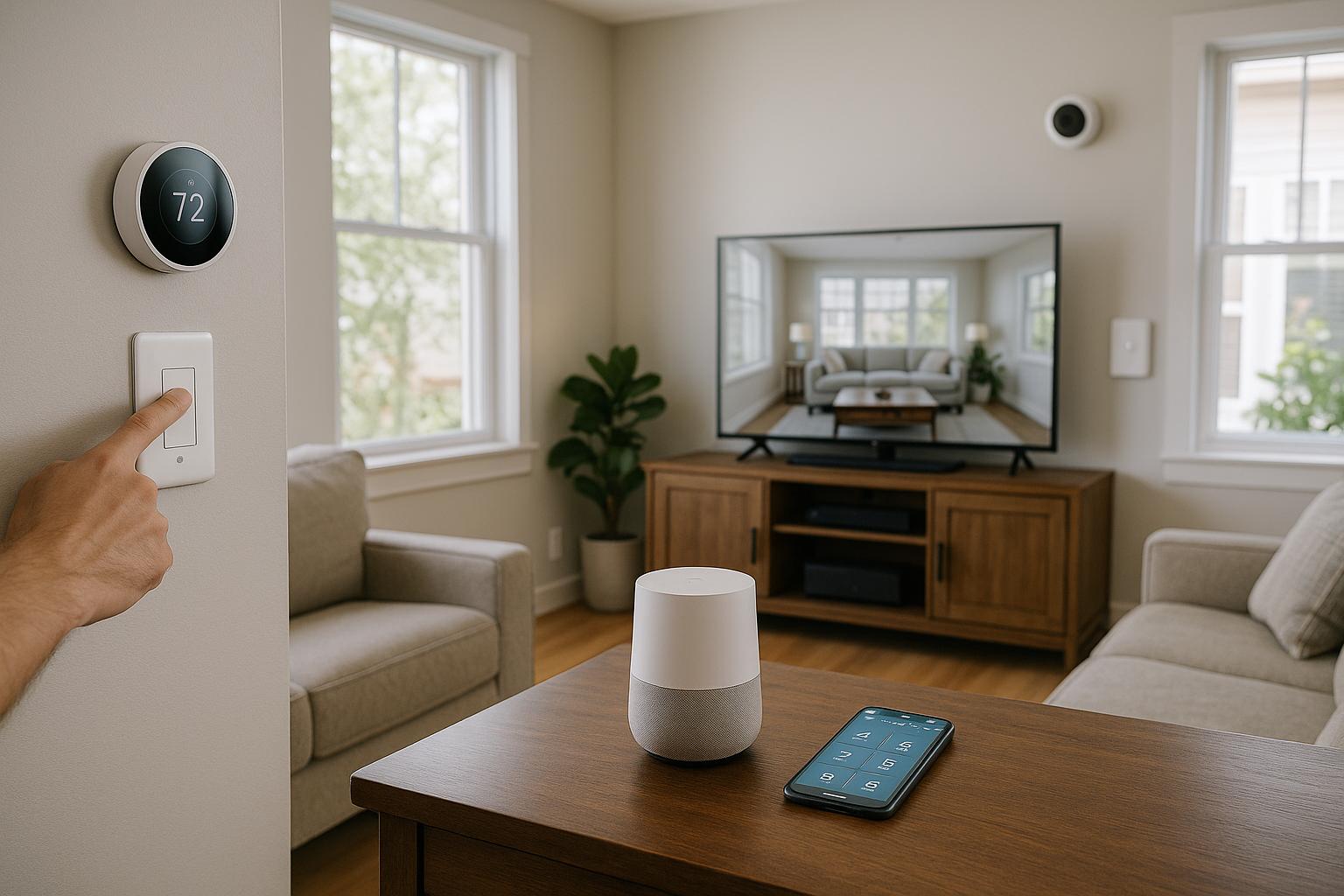
Smart home devices can collect far more information than their basic functions suggest. Cameras may record video, voice assistants can retain conversations, smart TVs can track viewing behavior, and thermostats or robot vacuums can reveal household routines. Understanding what each device senses, where information goes, how long it is retained, and which settings limit collection is essential for protecting privacy.
The Smart Home Privacy Question Americans Should Be AskingA smart home can make everyday life easier. Your thermostat adjusts the temperature before you arrive, a doorbell lets you see who is outside, a voice assistant answers questions without requiring your phone, and a robot vacuum cleans while you are at work.
The convenience is real. So is the data.
The important privacy question is not simply whether a device has a camera or microphone. It is what information the device can observe, what it sends to a manufacturer's servers, how long that information is retained, what other information it can be combined with, and who may ultimately have access to it.
That distinction matters because an IoT device can reveal information indirectly. A thermostat does not need a camera to provide clues about when someone is home. A robot vacuum does not need to record conversations to create a detailed map of a house. A smart TV does not necessarily need a microphone to learn a great deal about a family's entertainment habits.
Research from the National Institute of Standards and Technology has repeatedly identified privacy and security challenges in smart homes, including limited transparency and difficulty understanding what information devices collect. A 2025 NIST survey of 401 U.S. smart-home users found that perceptions and privacy practices vary considerably by device category, with voice assistants viewed as the most problematic category among the devices studied.
The issue is becoming more relevant as American households accumulate connected devices. Parks Associates has previously estimated that the average U.S. broadband household had 13 internet-connected devices, with that figure expected to rise substantially. More recently, its research reported that 54% of U.S. internet households experienced a data privacy or security issue during the preceding 12 months.
None of this means smart-home products are inherently unsafe or that consumers should disconnect everything. The more useful approach is to understand the information footprint of each device and make informed choices.
Here are seven categories that deserve particular attention.
1. Smart TVs Can Know What You WatchMost people think of a smart TV as a screen connected to Netflix, YouTube, Hulu, live television, or another streaming service. From a privacy perspective, however, the television can also become a source of detailed viewing information.
Many modern televisions include technologies commonly described as automatic content recognition, or ACR. Depending on the manufacturer, model, software and settings, these systems can identify content being displayed and use viewing information for recommendations, advertising, analytics or other purposes.
The important point is that the television does not necessarily need to know exactly what you are saying to generate a meaningful behavioral profile.
Consider an ordinary household. One person watches financial news every morning. The family watches children's programming around 7 p.m. A particular sports team is regularly viewed on weekends. Late-night streaming tends to consist of documentaries.
Over time, that viewing history can become surprisingly informative.
The FTC's 2017 action involving VIZIO illustrates why consumers should pay attention. According to the agency, VIZIO televisions collected second-by-second information about what appeared on the screen, including content from cable, broadband, set-top boxes, DVDs, over-the-air broadcasts and streaming devices. The FTC said information from 11 million televisions was collected without consumers' knowledge or consent. VIZIO ultimately agreed to pay $2.2 million and implement privacy-related requirements.
That case concerned practices from an earlier generation of smart TVs, but it demonstrates an enduring principle: a television can generate data about behavior even when its primary purpose appears to be entertainment.
What should you check?
Look through your television's settings for options involving:
- Viewing information
- Automatic content recognition
- Personalized advertising
- Advertising ID
- Recommendations
- Voice recognition
- Microphone permissions
- Diagnostics and usage data
The exact terminology varies considerably between manufacturers and operating systems. Disabling a particular tracking option may affect recommendations or advertising personalization, so consumers should understand the tradeoff rather than assuming every privacy setting is risk-free and consequence-free.
A practical rule is simple: if you do not need personalized recommendations or voice control, consider disabling the associated data collection features.
What Happens When Your AI Agent Gets Access to Your Email, Files and Apps? The New Security Problem Businesses Need to Understand
ChatGPT vs. Claude for Work: Which AI Is Actually Better for U.S. Businesses in 2026?
How Much Are U.S. Companies Really Spending on AI in 2026? The Numbers Behind the AI Spending Boom
Can AI Agents Actually Replace Business Software in 2026? What the “SaaSpocalypse” Debate Gets Right—and Wrong
Smart speakers and voice-enabled displays are among the most obvious privacy-sensitive devices because they are designed to listen for commands.
The common misconception is that the device either records everything continuously or records nothing until the wake word is detected. The actual architecture can be more complicated. Devices may process audio locally for wake-word detection and may transmit recordings or other information to cloud services when an interaction occurs. Features, settings and manufacturers differ.
Even accidental activations matter.
Imagine a family discussing an upcoming vacation. Someone says something that resembles the assistant's wake word. The device activates, records part of the conversation and sends it for processing. That is not the same as a company intentionally listening to every conversation in your house, but it illustrates why voice-enabled devices deserve careful configuration.
The FTC's case involving Amazon Alexa provides a particularly important example. In 2023, the FTC and Department of Justice alleged that Amazon retained children's Alexa voice recordings and related information longer than permitted and failed to properly honor some deletion requests. The settlement required Amazon to make changes involving deletion practices and privacy safeguards and included a $25 million civil penalty.
The lesson is broader than one company or product.
Voice data can be unusually sensitive because it can contain names, accents, household conversations, children's voices, questions about personal subjects, locations and information about other people who never intentionally interacted with the service.
Make voice assistants less invasive
Start by reviewing:
- Voice recording history
- Automatic deletion settings
- Human review or voice-analysis options
- Personalized results
- Location permissions
- Contacts and communication permissions
- Shopping or purchasing permissions
- Children's profiles
- Connected third-party services
If you have a smart speaker in a bedroom or another private area, consider whether it actually needs to be there.
The microphone-mute button can also be useful when you want a physical indication that the device is not actively listening for its wake word.
💡 Discover More from IOT & Blockchain

AI & Automation
AI Agents vs. AI Assistants: What’s the Difference—and Which One Should Your Business Use in 2026?
AI & Automation
The Future of Generative AI in Creative Industries
AI & Automation
Machine Learning in Healthcare: Transforming Diagnosis and Treatment

AI & Automation
How Artificial Intelligence Is Redefining Workplace Productivity
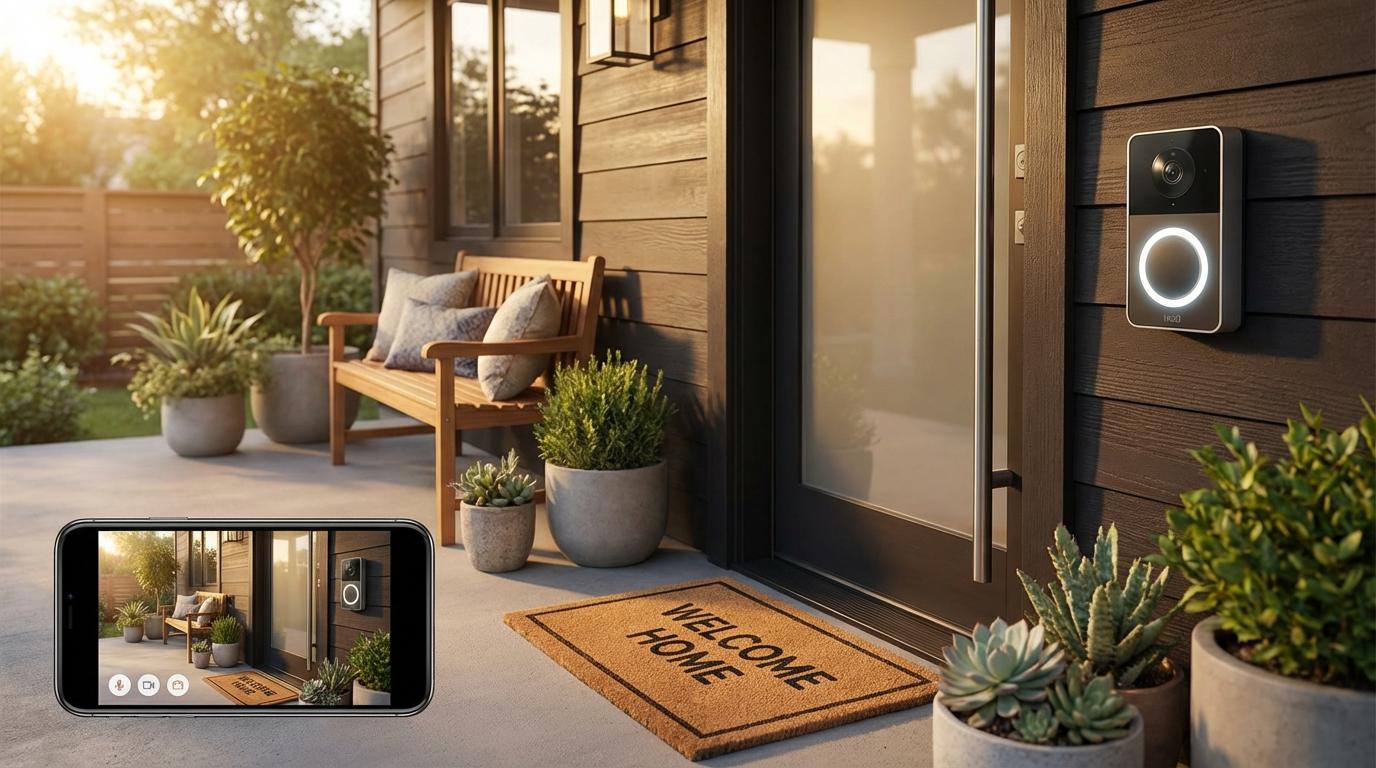
A security camera seems like an obvious privacy tradeoff: you exchange some privacy for protection and visibility.
But cameras can collect more than an isolated image of someone approaching the front door.
Depending on the system, a connected camera may process or store:
- Video recordings
- Audio
- Motion events
- Device locations
- Account information
- Facial or biometric information
- Time and date information
- Camera activity
- Household routines
The sensitivity is obvious. A camera inside a home can reveal who lives there, when they wake up, when they leave, who visits and what happens inside individual rooms.
The FTC's action involving Ring is one of the clearest U.S. examples of why camera privacy cannot be treated as a theoretical issue. The FTC alleged that Ring gave employees and contractors overly broad access to customers' private videos and failed to implement adequate safeguards against unauthorized access. The agency also alleged that hackers were able to gain control of accounts, cameras and videos.
The FTC later distributed millions of dollars in refunds connected with the settlement.
This does not mean a modern security camera is automatically vulnerable. It means the security of the account and cloud platform matters almost as much as the physical camera itself.
A better camera privacy strategy
For indoor cameras, think carefully about placement before thinking about settings.
A camera pointed at a front door is fundamentally different from one pointed at a bedroom.
If you do use indoor cameras:
1. Enable multifactor authentication.
2. Use a unique password.
3. Review who has shared access.
4. Check whether cloud recordings are necessary.
5. Review retention periods.
6. Disable audio if you do not need it.
7. Use physical privacy shutters where available.
8. Remove old users and old devices from the account.
NIST's consumer IoT guidance emphasizes security capabilities such as protecting data, managing device access and supporting secure software updates.
 4. Robot Vacuums Can Build Maps of Your Home
A robot vacuum may seem like one of the least concerning smart-home products.
It cleans floors. That's it, right?
Modern models can be considerably more sophisticated.
Depending on the product, a robot vacuum may use cameras, LiDAR, infrared sensors, microphones, Wi-Fi information or other technologies to navigate. Advanced models can create digital maps of rooms, recognize obstacles and remember where particular areas of the home are located.
That creates an interesting privacy issue: a floor map can reveal the structure of your home.
A map might indicate that a property has a large open kitchen, several bedrooms, a home office, a nursery or a particular arrangement of rooms. Navigation data can also provide clues about when the device operates.
NIST has specifically used smart-vacuum behavior as an example when discussing the information that connected devices can reveal. Its researchers noted that compromised data from a smart vacuum could potentially show when the vacuum was being used and where it operated within a house.
The practical risk is not necessarily that someone is sitting somewhere studying your floor plan. The concern is that seemingly mundane data becomes more revealing when combined with other information.
What to check on a robot vacuum
Look for settings related to:
- Home maps
- Room names
- Mapping history
- Camera access
- Cloud storage
- Voice assistants
- Location services
- Data sharing
- Diagnostic information
- Third-party integrations
If a vacuum supports local processing or local-only mapping, that may offer a privacy advantage, although consumers should verify what actually remains local rather than relying on marketing terminology.
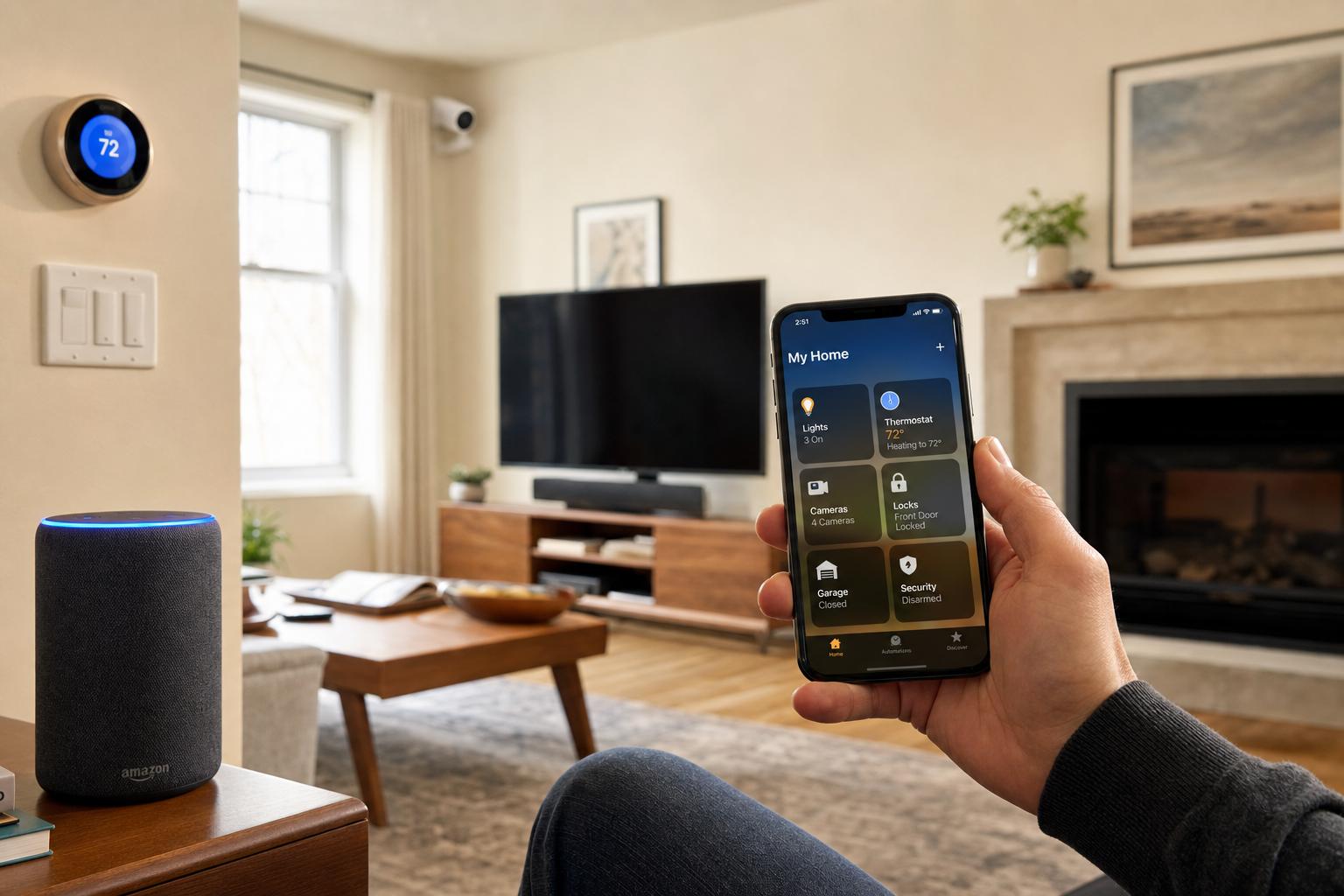
5. Smart Thermostats Can Reveal When You Are HomeA thermostat knows something surprisingly valuable: how your household behaves.
A connected thermostat can potentially process temperature settings, schedules, occupancy-related signals, device information, location information and usage patterns.
Individually, a temperature reading is not especially revealing.
A long-term sequence is different.
Suppose your thermostat routinely lowers the temperature at 8:30 a.m. on weekdays, raises it again around 5:45 p.m., and follows a different schedule on weekends. That pattern may reveal when people are generally home.
Some smart-home systems can also use geofencing, smartphone presence or other signals to determine whether residents are nearby.
The privacy concern is therefore less about a single temperature setting and more about behavioral inference over time.
This is an important concept for understanding IoT privacy generally. Data does not need to look personal to become personal.
A device may never ask, What time do you leave for work? Yet its data could make that pattern apparent.
Reduce unnecessary thermostat data
Review whether your thermostat needs:
- Precise location access
- Geofencing
- Detailed usage reporting
- Third-party integrations
- Voice assistant access
If you prefer predictable schedules, a traditional schedule may provide much of the convenience without requiring every possible automation feature.
The goal is not to make a thermostat dumb. It is to avoid collecting information simply because a feature happens to be available.
6. Smart Lighting and Plugs Can Reveal Daily RoutinesSmart bulbs, plugs and switches are often treated as harmless because they do not contain cameras.
That is understandable—but incomplete.
A smart plug can know when an appliance is switched on and off. Smart lighting can record automation schedules or device activity. A collection of smart switches can potentially create a timeline of household activity.
One light turning on at 6 p.m. tells you little.
Multiple connected devices changing state throughout the day can tell a much more detailed story.
For example, a household might have:
- Kitchen lights turning on around 6:30 a.m.
- Bedroom lights turning off around 7:15 a.m.
- Office equipment becoming active around 8 a.m.
- Living-room lights switching on around 6 p.m.
- Outdoor lights activating after sunset
- Bedroom lighting turning off around 11 p.m.
That is effectively a behavioral schedule.
NIST's 2025 research found meaningful differences in how U.S. consumers perceive privacy and security across device categories, including lighting, sensors, thermostats, security devices and voice assistants. The research highlights an important problem: people do not necessarily perceive lower-profile devices as carrying the same privacy implications as more obvious surveillance devices.
The best approach for ordinary households
Do not panic over every smart bulb.
Instead, ask: Does this device need cloud connectivity to perform the function I actually want?
If you only want a light to turn on at a certain time, a locally controlled timer may be enough.
If you want remote control, voice commands and complex automation, cloud connectivity may provide legitimate value. The privacy decision is then about whether that value is worth the additional data exposure.
7. Smart Home Hubs and Sensors Can Connect the DotsThe seventh category is arguably the most important because hubs and sensor systems can combine information from several devices.
A smart-home hub may connect thermostats, door sensors, motion detectors, lights, locks, cameras, speakers and other equipment.
Individually, each device produces a limited amount of information.
Together, they can create a detailed picture of a household.
Consider a hypothetical weekday:
At 6:45 a.m., the bedroom motion sensor activates.
At 7:02 a.m., the kitchen light turns on.
At 7:30 a.m., the front door opens.
At 7:34 a.m., the security system switches to away mode.
At 5:52 p.m., the thermostat detects the household returning.
At 6:01 p.m., the kitchen lights activate.
At 10:48 p.m., bedroom motion is detected.
None of these events individually looks particularly sensitive.
Together, they describe a routine.
This is why privacy experts often focus on the combination of data, not merely individual fields.
NIST's consumer IoT baseline emphasizes protecting data, securing device interfaces, managing cybersecurity state and supporting secure software updates across the product lifecycle.
A smart-home ecosystem therefore deserves a broader privacy review than simply checking the privacy settings on each individual gadget.
 How Much Smart-Home Data Is Actually Necessary?
A useful way to evaluate an IoT product is to separate functional data from optional data.
Functional data is information the product genuinely needs to perform its basic job.
Optional data can include information used for personalization, advertising, analytics, product improvement, research or other secondary purposes.
For example, a thermostat needs temperature information to regulate temperature. It may not need your exact location, extensive historical analytics or multiple third-party integrations to perform its basic heating and cooling function.
Likewise, a smart light needs to know when you want it turned on. It may not need a detailed record of every household lighting event stored indefinitely in the cloud.
This distinction gives consumers a much more useful privacy question: What data does this feature require, and what data does the company collect because the feature is convenient, personalized or commercially useful?
What Happens to Smart-Home Data After It Leaves the Device?One of the hardest privacy questions is also one consumers rarely ask: Where does the information go?
Some IoT products process information locally. Others send information to cloud infrastructure. Many use a combination.
Once data reaches a cloud service, several additional questions become relevant:
- How long is it retained?
- Is it encrypted?
- Who can access it?
- Is it used to improve algorithms?
- Is it shared with service providers?
- Is it used for advertising?
- Can you delete it?
- Does deletion remove backups and derived information?
- What happens if you close your account?
The answer may be buried in a privacy policy or separate help documents.
That is one reason NIST's research is significant. Its studies found that consumers can have concerns about smart-home privacy while still struggling to understand what devices collect and how to protect themselves.
Privacy should not require a cybersecurity degree.
Unfortunately, the reality is that consumers often have to do more research than they reasonably should.
How to Make Your Smart Home More Private Without Giving Up ConvenienceThe good news is that improving smart-home privacy does not usually require removing every connected device.
A few high-impact changes can make a substantial difference.
1. Secure the accounts before securing the gadgets
Use unique passwords for major smart-home accounts and enable multifactor authentication whenever available.
A sophisticated device connected to an account protected by a reused password is still vulnerable.
2. Review permissions once a year
Check which devices have access to:
- Microphones
- Cameras
- Location
- Contacts
- Bluetooth
- Home networks
- Other smart-home devices
Remove permissions that are not necessary.
3. Turn off features you never use
If you never use voice control, disable it.
If you do not need personalized advertising, turn it off.
If you do not need remote access to an indoor camera, consider disabling that function.
Every unused feature represents unnecessary complexity.
4. Keep devices updated
Security updates matter because connected devices can remain exposed for years.
NIST's IoT baseline specifically treats secure software updates as a core cybersecurity capability.
5. Consider separating IoT devices from personal computers
A separate guest or IoT network can help isolate smart devices from computers containing sensitive information.
This is particularly useful for households with numerous inexpensive devices from different manufacturers.
6. Remove devices you no longer use
An old smart plug sitting in a drawer may still be connected to an account.
When you replace a device, remove it from your account and follow the manufacturer's reset or decommissioning instructions.
7. Be selective about indoor cameras
Outdoor cameras, doorbells and indoor cameras have very different privacy profiles.
If a camera is not necessary in a bedroom, bathroom or other highly private area, consider leaving it out.
8. Read the privacy policy strategically
You do not need to read every legal sentence.
Search within the policy for terms such as: collect, retain, delete, share, advertising, analytics, voice, video, location, biometric, partners, service providers, artificial intelligence, machine learning, and third parties.
Those terms usually reveal the most important parts of the data lifecycle.
Are Smart-Home Devices More Dangerous Than Smartphones?Not necessarily.
The bigger issue is that people interact with them differently.
Most people expect a smartphone to collect substantial data. A person may be more surprised to learn that a light switch, vacuum cleaner or television also generates information.
NIST's research suggests this perception gap matters. Consumers' understanding, concerns and protective behaviors differ depending on the device category.
Smart-home products also occupy physical spaces where people relax and behave naturally. A camera watches a bedroom. A voice assistant sits near a kitchen table. A television sits in the family room. A thermostat observes household patterns.
That makes the context of collection particularly important.
What Should You Look for When Buying a New IoT Device?Before purchasing a smart-home product, privacy should be considered alongside price, compatibility and features.
Look for manufacturers that clearly explain:
- What information is collected
- Whether processing occurs locally
- Whether an account is mandatory
- How long data is retained
- Whether data can be deleted
- How security updates are delivered
- How long the product is supported
- Whether multifactor authentication is available
- Whether privacy controls are easy to find
- Whether the product works without unnecessary cloud services
NIST's consumer IoT cybersecurity profile was developed specifically to identify capabilities consumers commonly need from connected products.
Consumers should also remember that privacy and security are related but different.
A device can have excellent cybersecurity while still collecting extensive data.
Conversely, a company may collect relatively little information but have weak security controls.
The ideal product does both reasonably well.
Smart-Home Privacy Is About Patterns, Not Just Data PointsThe most important idea to take away from IoT privacy is that small pieces of information can become highly revealing when combined over time.
A thermostat knows temperature.
A smart plug knows whether an appliance is operating.
A door sensor knows whether a door opened.
A robot vacuum knows where it navigated.
A smart TV knows what content appeared on the screen.
A voice assistant knows what was said during interactions.
A security camera knows what happened in front of its lens.
When these systems communicate through a common platform, the resulting picture can become much more detailed than any single device suggests.
That does not automatically mean a company is misusing the information. It does mean consumers should understand what they are agreeing to.
A private smart home does not have to mean a disconnected home.
The better goal is intentional connectivity: choosing devices whose data practices you understand, enabling only the features you actually use, securing the accounts behind them and periodically reviewing what has changed.
That approach is more realistic than trying to eliminate every possible source of data collection.
The biggest privacy improvement may come from changing the way you evaluate smart-home products. Instead of asking only, What can this device do? ask four additional questions:
What can it see?
What can it hear?
What can it infer?
Where does that information go?
Those questions apply equally to a $30 smart plug and a sophisticated home-security system.
The future of the smart home will likely involve more automation, more sensors and more AI-powered features. Consumers do not need to reject that future. They do, however, need enough transparency and control to decide which conveniences are worth the information exchanged for them.
Stay in the Loop

You May Also Like
 AI & Automation 4 min read| 21 Jul 2026
Machine Learning Algorithms: An Overview of Popular Techniques and Their Applications
Machine learning algorithms play a pivotal role in today's data-driven world, enabling organizations to analyze vast amounts of data, uncover valuable insights, and make informed predictions. This article provides an overview of several key machine learning techniques and their diverse applications across various domains.
 IOT & Blockchain 5 min read| 12 Aug 2026
The Energy Paradox: Powering the Blockchain Revolution Sustainably
Blockchain technology faces challenges in energy consumption, but innovative solutions aim to make blockchain operations more sustainable.
 Cloud & SaaS 12 min read| 13 Sep 2026
Cloud vs. On-Premises AI: When Does Buying Your Own AI Hardware Actually Make Financial Sense?
Buying AI hardware can beat cloud costs when GPU workloads are large, predictable, heavily utilized, and expected to remain stable for several years. For most growing businesses, however, cloud GPUs remain financially safer because they avoid upfront capital costs, hardware obsolescence, facilities expenses, staffing overhead, and idle capacity. The best choice often combines cloud flexibility with selective on-premises capacity carefully.
 AI & Automation 7 min read| 06 Sep 2026
The Challenges of Bias in AI: Can Machine Learning Ever Be Truly Fair?
The issue of bias in Artificial Intelligence (AI) and machine learning is a critical concern that affects the fairness and reliability of these technologies. As AI systems become increasingly integrated into various aspects of our lives, from hiring practices to law enforcement, it is essential to address the challenges of bias to ensure that machine learning models operate equitably and without discrimination.